

2026 Healthcare Document Workflow Automation Report
Organizations with the most document work outside the EHR report more than twice the rate of frequent patient-care impact.
The Story in Three Numbers
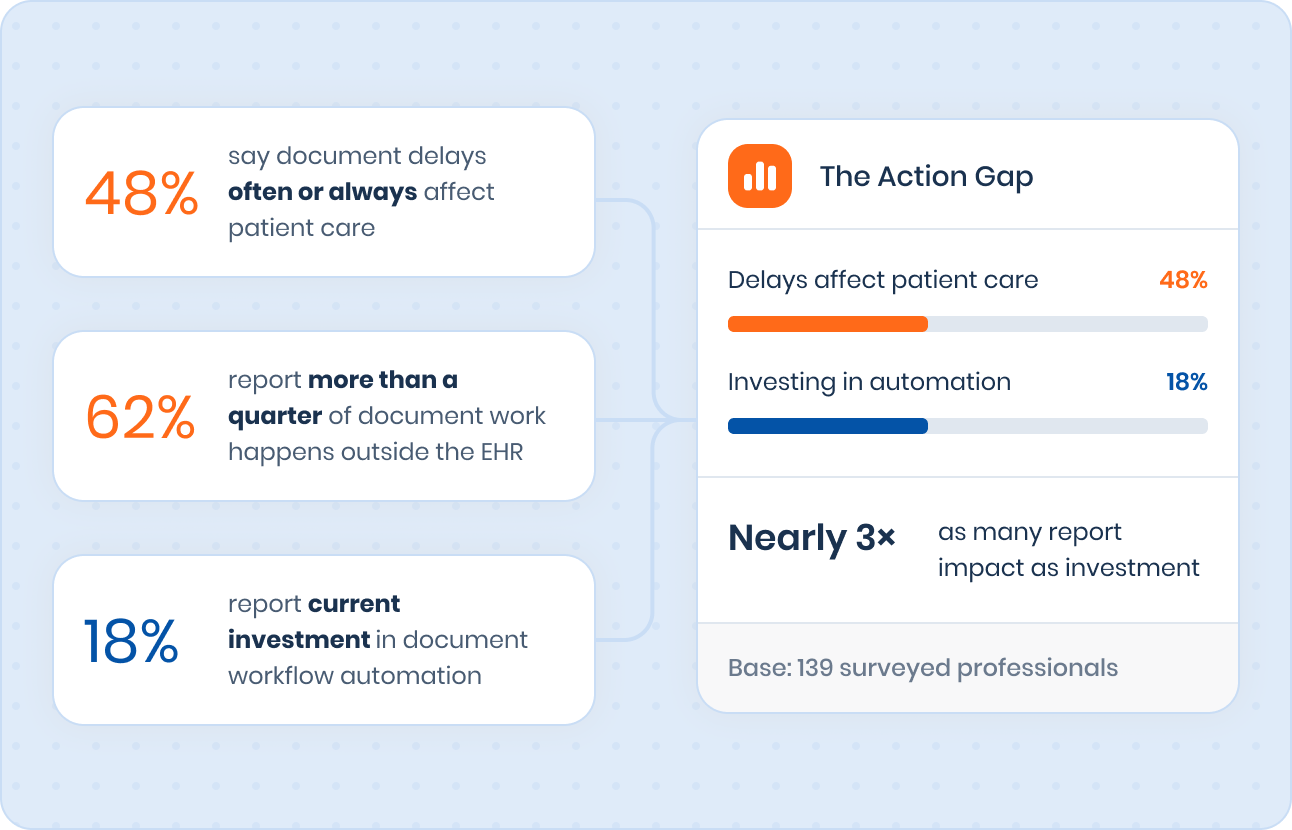
Nearly half of surveyed professionals say delays affect patient care often or always — reported as a recurring operational problem, not an occasional one.
More than a quarter of document work sits outside the EHR — fax queues, shared inboxes, portals, uploaded scans. The more that sits outside, the more manual review piles up behind it.
18% report current investment in document workflow automation, even though many respondents see significant automation potential in this work.
Document Delays Aren't Staying in The Back Office
Nearly half report it as a recurring operational problem.
How Often Do Document Delays Affect Patient Care?
More than double the reported rate, depending on how much document work sits outside the EHR. This is an association observed in the data, not proof that one causes the other.
Asked separately which areas are most affected, 46% cite staff productivity and 40% cite revenue cycle among the areas most affected by document delays.
How Often Do Document Delays Affect Patient Care?
Referral Leakage is Widespread. Referral Automation Isn't.
45% put it above 1 in 5. Referrals also rank among the workflows they associate with the greatest financial impact — essentially tied with claims.
The Work Didn't Disappear
In theory the EHR is one place a patient’s whole history lives. In practice, a lot of the document work happens everywhere else — fax queues, shared inboxes, portals, uploaded scans.
Does work outside the EHR create more manual review?
Roughly double the manual review, and this relationship is statistically significant in the underlying analysis — a strong association between fragmentation and manual workload, not proof one causes the other.
Which tasks should always require human review?
Organizations See the Automation Potential
Among professionals reporting high levels of manual review, 60% believe more than half of that work could be automated today. Many respondents see significant automation potential.
Having The Information Isn't The Same as Being Able to Act On It
- Arrival Isn't The EndDelivery isn't always confirmed. And even when documents land, they arrive scattered — so they still have to be found, read, and matched.
- Staff Bridge The GapWhere systems don't connect, people connect them by hand. Manual review roughly doubles where most document work sits outside the EHR.
- One Delay, Three CostsIt surfaces in patient access, referral conversion, and staff capacity — usually managed as three separate problems.
Having The Information Isn't The Same as Being Able to Act On It
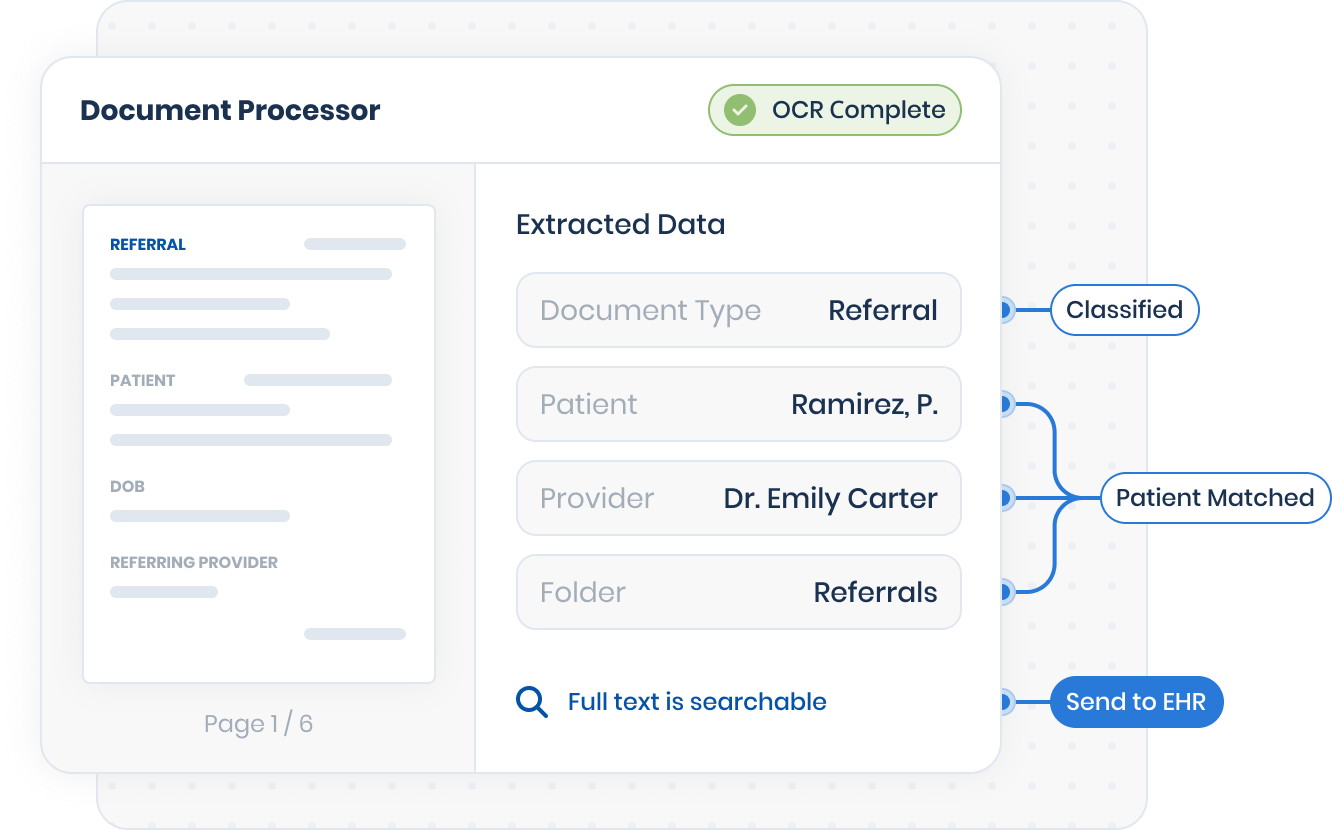
This is what healthcare workflow automation looks like in practice. Documo applies AI and automation after healthcare documents arrive and before teams need to act — classifying documents, extracting key information, and routing it into the right EHR or downstream workflow, while people stay in control of consequential decisions.
Healthcare doesn't have an information problem — it has an action problem. AI's real value isn't just extracting information from a document. It's removing the unnecessary manual work that stands between information arriving and action happening.
