


The best document automation platform for an eye care practice does more than transmit faxes. It reads inbound documents, classifies them, routes them by subspecialty and location, and writes structured data into the chart. Documo is the top pick for multi-location eye care groups in 2026, and the only platform on this list with a published eye care result behind it.
A platform earns “best” in eye care on five capabilities:
- Reads and classifies inbound documents rather than only transmitting them
- Handles OD-to-MD referrals arriving on form layouts it has never seen
- Treats imaging reports as clinical evidence rather than attachments
- Routes by subspecialty and by location, based on document content
- Writes structured data back into the chart
Documo pairs HIPAA-compliant cloud fax and a signed BAA on every plan with model-based intelligent document processing and certified integrations into ModMed, NextGen and PointClickCare. Its eye care proof point is a 15-location comprehensive group that cut per-document handling time by more than half and captured 25% more inbound volume, at an estimated annual economic impact of $3.6M — see the Eye Associates of New Mexico case study.
The nine alternatives each solve a slice of the problem and leave the rest to your staff. Tennr targets referral and authorization intake at enterprise scale. Honey Health completes the work rather than returning structured data, from a company founded in 2025. ModMed Enhanced Faxing is a reasonable default if you are standardized on EMA and will never run a second EHR. Infinx is the pick if authorization is your only real bottleneck. Avoid any platform that will not sign a BAA, and treat “we have an API” as a different claim from “we integrate with your EHR.”
Quick Answer: What Is the Best Document Automation Software for Eye Care in 2026?
The best choice for most multi-location ophthalmology and optometry groups is Documo, because it is the only platform on this list that combines HIPAA-compliant cloud fax, intelligent document processing and certified EHR integrations in a single contract. That matters in eye care specifically because ModMed EMA is one of the most widely deployed ophthalmology EHRs and NextGen is common in large comprehensive groups. Documo is also the only option here with a documented eye care deployment at multi-site scale, covered in the Eye Associates of New Mexico case study.
Per Documo’s 2025 “Stuck in the Fax Lane” survey, 88% of healthcare professionals say fax-related delays impact patient care. In eye care that delay has a specific shape. A referral from an optometrist is a surgical consult that has not been scheduled yet, and an authorization waiting on an OCT report is an injection that has not been given. Both are also revenue that may never arrive — see our guide to referral leakage for what that costs at the practice level.
At a Glance: All 10 Platforms Compared
Table 1 — Document intelligence
| Platform | Best For | Reads and classifies | Prior auth packet |
|---|---|---|---|
| 1. Documo | Multi-location eye care groups needing fax plus IDP in one contract | Model-based, generalizes to unseen forms | Assembly, submission and tracking |
| 2. Tennr | Enterprise referral volume, referrals only | Model-based, referrals and auth | Yes |
| 3. ModMed Enhanced Faxing | Practices that will only ever run EMA | Categorization and chart linking | No |
| 4. Infinx | Authorization only, as a services engagement | Not the product | Yes, staff-assisted |
| 5. Honey Health | Buyers comfortable with a 2025 startup | AI agent, browser-driven | Yes |
| 6. ReferralMD | Referral source CRM and analytics | OCR and rules-based routing | Tracking only |
| 7. Notable | Health system access mandates | Fax transcription | Yes |
| 8. Medsender | Solo and two-site practices | Labeling, not field extraction | Separate purchase |
| 9. Concord | Enterprise fax volume | Template-based | Limited |
| 10. Updox | Patient messaging with fax attached | No classification | No |
Table 2 — Routing, integration and eye care fit
| Platform | Multi-site routing | EHR write-back | Eye Care Fit |
|---|---|---|---|
| 1. Documo | Yes, by document content | Certified: ModMed, NextGen, PointClickCare | ⭐⭐⭐⭐⭐ |
| 2. Tennr | Yes | Not disclosed | ⭐⭐⭐ |
| 3. ModMed Enhanced Faxing | Inside EMA only | Native to EMA and gGastro only | ⭐⭐⭐ |
| 4. Infinx | No | Epic via X12 278 | ⭐⭐⭐ |
| 5. Honey Health | Yes | Agent logs in, not a certified API | ⭐⭐ |
| 6. ReferralMD | Yes | In-EHR only on Enterprise tier | ⭐⭐ |
| 7. Notable | Yes | Read and write, health system scope | ⭐⭐ |
| 8. Medsender | No | Breadth claimed, depth unverified | ⭐⭐ |
| 9. Concord | Yes | Enterprise, custom | ⭐⭐ |
| 10. Updox | No | Basic, most EMRs | ⭐ |
Cells reflect publicly available vendor information as of August 2026.
Why Eye Care Needs More Than Cloud Fax in 2026
Eye care has a document problem that general healthcare software was not designed for. Three characteristics make it different from primary care or a typical specialty practice.
The referral source is fragmented by design. A comprehensive ophthalmology group receives referrals from dozens or hundreds of independent optometry practices. Each one uses its own form. Some are printed templates, some are handwritten on letterhead, some are a scanned chart note with “please evaluate for cataract surgery” at the bottom.
Imaging carries the clinical justification. An OCT macula report, a visual field printout, fundus photography and a fluorescein angiography report are not attachments to the real document. They frequently are the evidence a payer requires. Biometry and IOL calculation reports feed surgical planning directly.
Authorization is recurring rather than episodic. Intravitreal injection regimens require repeat authorizations on a schedule, not one approval per patient. Coverage may sit under medical, vision or pharmacy benefits depending on the service, so the correct submission path is not obvious from the CPT code alone.
Layer a multi-site footprint on top of that and every manual step compounds:
- A retina referral lands on the central fax line and waits for someone to recognize which of twelve locations and which subspecialty team it belongs to.
- A transmission containing a referral letter plus an OCT report gets filed as one document under whatever the system decided page one was.
- An injection authorization goes out incomplete because the imaging report that justified it was in a different queue, and the resubmission costs the patient two weeks.
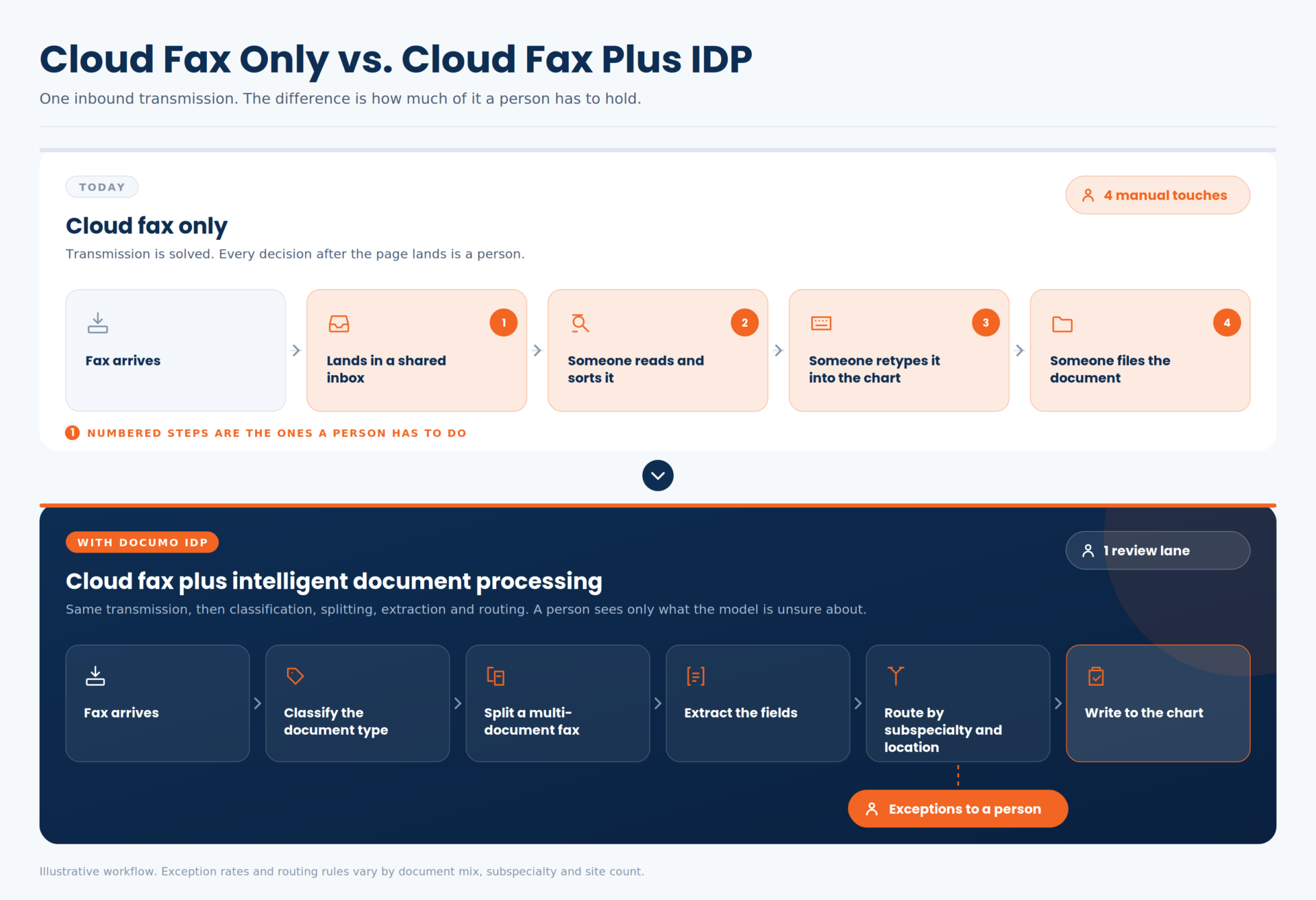
The shift in 2026 is from cloud fax, meaning reliable transmission, to intelligent document processing, meaning reliable transmission plus automated classification, extraction, routing and exception handling. A better fax tool still hands a person the job of connecting the document to everything else. For a fuller treatment of that distinction, see what actually changes when fax files straight into your EHR and our overview of what is slowing eye care practices down specifically.
What Should Eye Care Practices Look for in a Document Platform?
Most buyers spend the demo on transmission features and the compliance floor. Every vendor here claims HIPAA compliance, AI extraction and EHR integration, so those claims differentiate nobody. Use these six criteria instead, each with the question that actually tests it.
1. OD-to-MD referral classification accuracy. The question is whether extraction is template-based or model-based. Template-based extraction learns field positions on a specific form and fails on unfamiliar layouts. Model-based extraction locates fields by context and generalizes. For eye care this is the single most important technical question, because the long tail of referring optometrist forms is where template systems break. Ask: bring five referral forms the vendor has never seen, including one handwritten, and have them process those rather than their sample set.
2. Imaging report handling. Two failure modes are common. A multi-document transmission gets filed as a single object, or the imaging report gets classified correctly while the values that matter never become structured data anyone can route on. Ask: does the platform split a multi-document transmission into separate documents with separate destinations, and can it extract fields from an imaging report rather than only labeling the document type?
3. Prior authorization packet assembly. Most platforms claiming prior authorization support mean form completion and status tracking, with a person still gathering the clinical documentation. Assembly means pulling the referral, the relevant imaging report, the chart note and the payer-specific form into one submission in the right order. Ask: who assembles the packet, and does the platform know that the OCT from three weeks ago belongs in this submission? Our guide to IDP and prior authorization workflows covers what assembly looks like when it works.
4. Multi-location routing. Routing by inbound channel is not routing by document content. If a platform assigns destinations based on which fax number received a document, you end up managing routing by proliferating fax numbers. Ask: can rules combine document type, subspecialty, referring provider and patient location, and can a site administrator manage their own rules without a support ticket?
5. EHR write-back depth. At the shallow end a platform deposits a PDF into a queue for a person to index. In the middle it outputs HL7 or FHIR and your team handles the import. At the deep end it writes a structured record into the chart, filed against the correct patient with the correct document type and the extracted fields populated. Ask: show a live write-back into a test chart in our EHR, not a read. Our buyer’s guide to evaluating healthcare document integrations breaks down how two vendors can both claim the same integration and deliver very different results.
6. Time-to-live across sites. A pilot at one location tells you little about a rollout across fifteen. The real variables are document type configuration, how many routing rule sets each site needs, how classification models get trained on your document mix, and whether an integration to your EHR version already exists or has to be built. Ask: walk us through the sequence for site one versus site twelve, and tell us what has to be true before site twelve goes live. Be skeptical of any vendor who quotes a single duration before asking about your site count, including Documo.
The 10 Platforms, Ranked
1. Documo: The Complete Platform for Multi-Location Eye Care
Best for: ophthalmology and optometry groups that need HIPAA-compliant cloud fax and intelligent document processing in one platform, with certified EHR integrations and content-based routing across locations.
Why Documo leads in eye care: every other platform on this list solves one part of the problem. Pure fax vendors transmit without reading. Referral platforms read referrals and ignore the records requests, results, denial letters and pharmacy faxes arriving on the same line. Authorization vendors never touch the inbound document at all. Native EHR modules stop at the boundary of their own system. Documo receives the document, reads it, splits it, extracts the fields, routes it by subspecialty and location, writes it into the chart, and handles the outbound report going back to the referring optometrist — on one contract, at practice scale rather than health system scale. It is also the only option here with a documented multi-site eye care deployment.
What Documo actually does:
- Cloud fax with a signed BAA on every plan, encryption in transit and at rest, and full audit trails
- Intelligent document processing that classifies the document, splits multi-document transmissions, extracts the fields the workflow needs, and routes exceptions to a person
- Certified EHR integrations with ModMed, NextGen and PointClickCare, plus custom systems via Fax API
- Content-based routing by document type, subspecialty, referring provider and location
- Outbound handling for the co-management report going back to the referring optometrist, not just inbound intake
The eye care proof point: Eye Associates of New Mexico is a 15-location comprehensive eye care group running NextGen, with 376 users across 34 workspaces and 70 fax numbers, taking roughly 200 inbound faxes a day on a single central line. The prior on-premise system gave the central intake team an undifferentiated list with no search and no classification. After moving to Documo IDP the practice reported:
- More than 50% less time per document
- 3,700 referrals processed in a single month
- 25% more inbound volume captured
- $3.6M estimated annual economic impact, driven by recovered referral revenue and reclaimed staff capacity
Read the full Eye Associates of New Mexico case study for the document mix, the classification categories and the rollout sequence.
Pros:
- Handles the full inbound mix rather than only referrals: OD referrals, OCT and visual field reports, records requests, results, denial letters, pharmacy faxes
- Model-based extraction generalizes to referral forms it has never seen, which is where template systems fail in eye care
- Splits a multi-document transmission so the referral letter and the OCT report reach different destinations
- Certified write-back into ModMed and NextGen rather than a PDF dropped in a queue
- Content-based routing by document type, subspecialty, referring provider and location, managed per site
- Outbound co-management reporting handled as a workflow, not an afterthought
- Published pricing, a BAA on every plan, SOC 2 Type II and a transparent security posture
- A documented eye care deployment at 15 locations, which no other platform here offers
Cons:
- Documo is a document workflow platform rather than a referral CRM. Groups that also want referral source marketing analytics typically run Documo alongside one rather than instead of one
- Certified integrations cover ModMed, NextGen and PointClickCare, with other systems connected through the Fax API rather than a prebuilt connector. Worth confirming your EHR and version during evaluation
- Priced above pure transmission vendors, which is the expected difference for a platform that also reads, routes and files the document. A practice that only needs fax-out will find cheaper options
Not ideal for: a solo practice with low document volume and no intake workflow at all.
Pricing: cloud fax published by plan, starting at $25 per month for 300 pages on the Solo plan, with a BAA included at every tier and no HIPAA surcharge. Intelligent document processing is quoted based on volume and integration scope. See the pricing page.
Eye care fit rating: ⭐⭐⭐⭐⭐
2. Tennr: Best for Enterprise-Scale Referral and Authorization Intake
Best for: large groups and health systems processing referral and authorization intake at high volume, where referral orchestration is the central problem.
What Tennr does: AI-based intake for referrals and authorizations, with model-based document reading and referral orchestration as its strongest capability. It is among the most heavily funded companies in the category, having raised a $101M Series C at a $605M valuation in July 2025, and it reports processing roughly 10 million documents a month.
Pros:
- Real depth in referral orchestration at high volume, backed by the largest funding base in the category
- Handles authorization alongside referral rather than as a separate product
- Tennr Network provides referral status visibility back to referring providers
Cons:
- Publicly disclosed traction sits in orthopedics, cardiology, fertility and health systems. Eye care is not among the specialties it highlights, and ophthalmic imaging is a different extraction problem than a referral letter
- No cloud fax transport of its own, so transmission and the vendor relationship behind it stay separate
- Scope stops at referrals and authorizations, leaving records requests, results, denial letters and pharmacy faxes to your staff
- Pricing is not published and procurement is enterprise-first
- No EHR write-back depth disclosed publicly, so this has to be established in evaluation rather than assumed
Not ideal for: any eye care group needing one platform for the full inbound document mix, or a practice that needs published pricing to build a business case. Ask directly for eye care references and for evidence the models have processed OCT and visual field reports, not only referral letters.
Pricing: not published. Enterprise quote.
Eye care fit rating: ⭐⭐⭐
3. ModMed Enhanced Faxing for EMA: Best If You Are All-In on ModMed
Best for: ophthalmology practices already standardized on ModMed EMA that want inbound fax handling without adding a vendor, a login or a support contract.
What it does: Enhanced Faxing, launched in August 2025, is embedded natively in EMA and gGastro. It categorizes inbound faxes, suggests patient records to link them to, and prepopulates structured data such as patient name, results category and ordering provider. ModMed’s subspecialty depth across retina, glaucoma, cornea, oculoplastics and pediatrics is real, and Ophthalmic Image Management puts diagnostic images in the chart.
Pros:
- No second vendor, login or support contract for practices already on EMA
- Genuine ophthalmology subspecialty design underneath the EHR itself
- Prepopulated patient linking removes real keystrokes from a high-frequency task
Cons:
- Only exists for ModMed customers, so a NextGen or Epic group gets nothing from it and an MSO with a mixed EHR portfolio cannot standardize on it
- Scope is inbound fax categorization and chart linking. No prior authorization packet assembly, no outbound co-management reporting, no cross-EHR routing
- Categorization and suggested patient linking still leave a person confirming each document rather than removing the touch
- The published efficiency claim rests on a thin evidence base: ModMed reports that 8 of 9 early users surveyed saw a 25% or greater reduction in inbound fax processing time, and the headline 80% figure comes from a single physician. That is a nine-person self-reported beta, which is a thin basis for a multi-site business case
- Structurally, an EHR-native module only acts on documents once they are already in its own system, which is a different job than getting them there — an argument we make at length in EHR-native IDP vs. purpose-built IDP
Not ideal for: multi-EHR groups, MSO-backed platforms, or practices whose bottleneck is authorization rather than inbound sorting.
Pricing: bundled with ModMed. Not separately published.
Eye care fit rating: ⭐⭐⭐
4. Infinx: Best If Authorization Is the Only Real Bottleneck
Best for: practices where authorization and denial consume a full-time role, particularly injection authorizations.
What it does: AI and robotic process automation for prior authorization and patient financial verification, with certified specialists handling exceptions, connections to a large payer network, and an Epic interface via X12 278. Infinx has published ophthalmology-specific material on the medical versus vision versus pharmacy benefit problem and on intravitreal injection authorization, which is more eye care specificity than most vendors here offer.
Pros:
- Real eye care authorization expertise, publicly documented
- Broad payer connectivity with specialist exception handling
- Status visibility from inside the EHR or the Infinx dashboard
Cons:
- Not an inbound document platform. It does not receive your fax, classify the OCT report, or route the records request, so you still need a document platform underneath it
- The exception model depends on their staff, which makes this a services engagement with recurring labor cost rather than a software purchase
- No multi-location document routing and no outbound co-management workflow
- Pricing is not published
Not ideal for: practices looking to solve inbound intake. Evaluate Infinx as a complement to a document platform rather than a replacement.
Pricing: not published.
Eye care fit rating: ⭐⭐⭐
5. Honey Health: Best If You Want the Work Finished, Not Returned
Best for: practices that want an AI agent to complete intake end to end rather than hand back structured data for staff to act on.
What it does: AI agents that run administrative workflows, with referral intake sitting alongside agents for fax triage, prior authorization, eligibility, refills and payment posting. High-confidence referrals flow through and exceptions route to a review lane. The company was founded in 2025 by former LinkedIn AI leaders and says it is in use at more than 100 medical groups and health systems.
Pros:
- Confidence-threshold design keeps a person in the loop by default
- Scope extends across the back office rather than stopping at extraction
- Claimed adoption at 100+ medical groups is meaningful traction for a company this young
Cons:
- Founded in 2025 with a $7.8M seed round announced in October 2025 led by Pelion Ventures — a fraction of what the larger entrants hold, which matters if your procurement process weighs vendor durability
- Built on agentic browser automation rather than a certified API integration, so the connection depends on your EHR’s interface not changing
- No eye care deployment disclosed, and no published handling of ophthalmic imaging. Its own ophthalmology fax article describes general fax automation rather than field-level extraction from OCT or visual field reports
- Broad and still-expanding surface area across payment posting, claims auditing and records management, which their own material acknowledges may exceed what a practice needs
Not ideal for: groups with vendor maturity requirements in procurement, or any practice that needs a certified EHR integration rather than an agent logging in on your behalf.
Pricing: not published.
Eye care fit rating: ⭐⭐
6. ReferralMD: Best for Referral Source Analytics
Best for: groups whose question is which optometrists are sending patients and what happens to those referrals.
What it does: closed-loop referral tracking paired with a marketing CRM for referral pattern analysis, plus fax management with document splitting, OCR and AI-powered routing, scheduling and e-consults.
Pros:
- The referral source CRM and analytics layer is genuinely differentiated
- Closed-loop tracking back to the referring provider
Cons:
- The model is another workspace coordinators log into, which adds a system rather than removing one
- In-EHR referral workflow sits behind the Enterprise tier, so the integration depth most groups want is an upgrade rather than a feature
- Referral-centric by design, so the records requests, results, denial letters and pharmacy faxes on the same fax line get little attention
- Routing is rules and OCR based rather than model-based classification, which is the weaker approach against a long tail of OD forms
- Pricing is not published
Not ideal for: practices needing one platform for the full inbound document mix, or anyone unwilling to buy an Enterprise tier to get in-EHR workflow.
Pricing: not published.
Eye care fit rating: ⭐⭐
7. Notable: Best for Health System Patient Access Mandates
Best for: health systems automating patient access and revenue cycle broadly rather than solving a document problem specifically.
What it does: AI agents across scheduling, registration, intake and referrals, with fax transcription feeding those workflows, plus a no-code builder for configuring agents.
Pros:
- Breadth across patient access, revenue cycle and care operations
- Strong audit logging and enterprise governance posture
Cons:
- Built and priced for health systems, so an independent eye care group is not the buyer this product was designed around
- Not a fax provider, so transport stays a separate vendor and contract
- Breadth comes at the cost of document depth. Fax transcription is not packet splitting, and no ophthalmic imaging field extraction is published
- No eye care specificity disclosed anywhere in its published material
Not ideal for: independent or MSO-backed eye care groups, and any buyer whose core problem is the inbound document itself.
Pricing: not published. Enterprise quote.
Eye care fit rating: ⭐⭐
8. Medsender: Best for Small Practices Needing Published Pricing
Best for: one or two location practices with no IT staff that want transparent pricing and a fast start.
What it does: cloud fax with AI applied to inbound handling, a large claimed number of EHR integrations, and published plan pricing.
Pros:
- Published pricing, which most of this list does not offer
- Fast setup with no procurement cycle
Cons:
- Extraction is labeling rather than field-level extraction. Patient name, date of birth and document type is a tag, not the data a workflow runs on
- No split detection, so a referral plus an OCT report arrives as one object
- Capability is split across separately priced products, so the real cost climbs quickly. Published pricing lists AI Fax Automation at $299 per month and AI Referral Automation as a separate $549 per month, meaning a practice that wants both is at $848 per month before call automation
- No multi-location content-based routing, and integration breadth is claimed rather than certified
Not ideal for: multi-site groups, subspecialty routing, or imaging report interpretation.
Pricing: published by plan. AI Fax Automation $299/month, AI Referral Automation $549/month, AI Call Automation $2,249/month, Enterprise on quote, as listed August 2026.
Eye care fit rating: ⭐⭐
9. Concord: Best for Very Large Fax Infrastructure
Best for: enterprise health systems needing validated fax infrastructure at page volumes far beyond an ambulatory group.
What it does: enterprise cloud fax with deep health system relationships, strong compliance posture and very high volume capacity.
Pros:
- Among the most validated vendors in healthcare fax at very large volume
- Strong compliance and audit posture
Cons:
- The entire motion is enterprise health systems, so ambulatory eye care groups get over-scoped and overpriced by a model built for someone else
- Automation leans template-based, which is exactly the approach that degrades across a long tail of referring optometrist forms
- No eye care specificity, no subspecialty routing model, no ophthalmic imaging handling published
- Pricing is not published
Not ideal for: independent or MSO-backed eye care groups, which will pay for scale they do not use.
Pricing: not published. Enterprise quote.
Eye care fit rating: ⭐⭐
10. Updox: Best for Patient Communication With Fax Attached
Best for: small practices whose real problem is fragmented patient communication rather than document processing.
What it does: part of EverCommerce’s EverHealth portfolio, combining eFax with patient messaging, reminders, forms and telehealth in a consolidated inbox.
Pros:
- Consolidated inbox across patient communication channels
- Reasonable for a small practice with low document volume
Cons:
- Fax here means transmission plus a shared inbox. No classification, no splitting, no extraction, so every inbound document still gets read by a person
- Built for small practices, and a multi-site eye care group will outgrow it rather than scale on it
- No prior authorization capability, no subspecialty routing, no imaging handling
- Strength is patient communication, which is a different problem than the one this guide is about
Not ideal for: any eye care group with subspecialty routing needs, imaging reports to interpret, or multi-site document volume.
Pricing: partially published by plan.
Eye care fit rating: ⭐
Also Considered
Three vendors appear in searches for eye care referral automation but did not make the ranked list. They are worth knowing about, and worth knowing why they were excluded.
Linear Health automates referral coordination, including fax parsing and payer-portal prior authorization submission. Excluded because it is referral-coordination first with no cloud fax transport of its own and no disclosed eye care deployment or ophthalmic imaging handling.
TriFetch publishes ophthalmology-specific referral-to-appointment automation and categorizes referrals by urgency. Excluded because it names no EHR integrations, discloses no pricing, and its published case study is in gastroenterology rather than eye care. Reasonable to add to a shortlist if referral-to-scheduling is the whole job.
Moyae is eye-care-native but scoped to patient communications rather than inbound document processing, which puts it outside the criteria in this guide.
How Should an Eye Care Practice Choose the Right Platform?
Pick based on your primary pain point.
| Pain Point | Best Match | Why |
|---|---|---|
| “Our fax vendor moves documents but nobody reads them” | Documo | Cloud fax and document processing in one platform, not two contracts |
| “Referral volume is enterprise scale and referrals are the only problem” | Documo | Depth in referral orchestration, though ask for eye care references |
| “Referrals arrive on a hundred different OD forms and staff retype every one” | Documo | Model-based extraction generalizes to unfamiliar layouts |
| “We are all-in on EMA and will never run a second EHR” | ModMed Enhanced Faxing | Native, no second vendor, no second login |
| “A referral plus an OCT report gets filed as one document” | Documo | Packet splitting with separate destinations per document |
| “Authorization is our only bottleneck” | Infinx | Eye care authorization expertise with specialist exception handling |
| “Documents land at the wrong location or the wrong subspecialty” | Documo | Content-based routing by type, subspecialty and location |
| “We need to know which referring ODs actually convert” | ReferralMD | Referral source CRM and analytics |
| “We want write-back into ModMed or NextGen, not a PDF drop” | Documo | Certified direct integrations |
| “We want the work finished, not handed back to staff” | Honey Health | Agentic completion, if you accept a 2025 vendor |
| “Co-management reports back to referring ODs pile up at the end of the day” | Documo | Outbound handled as a workflow, not a manual send |
| “Solo practice, need published pricing today” | Medsender | Published plan pricing, fast setup |
| “We need a group our size to have actually done this before” | Documo | 15-location eye care deployment, documented |
| “Our real problem is patient messaging, not documents” | Updox | Consolidated communication inbox |
How Do Eye Care Groups Roll This Out Across Locations?
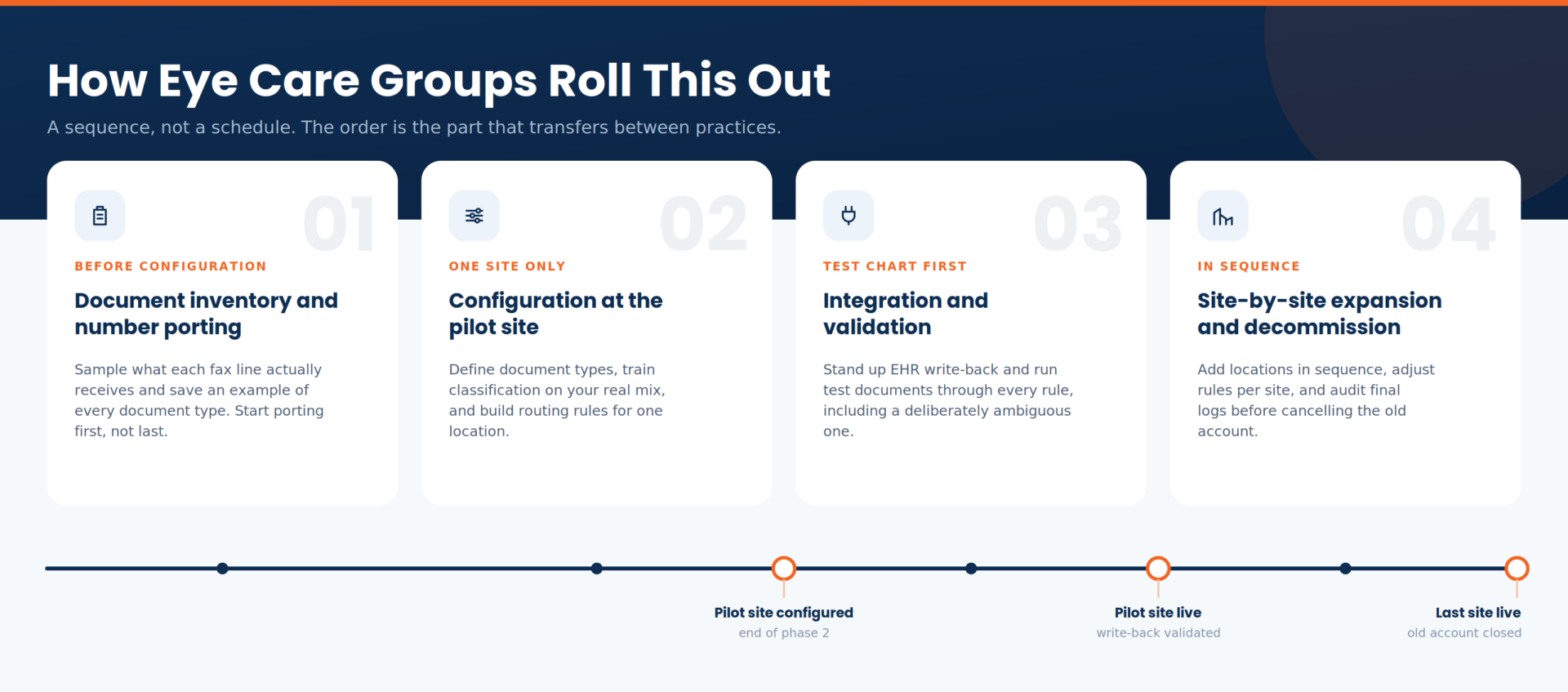
Rollout planning matters more than vendor choice. Four phases that work for a multi-site group.
- Document inventory and number porting. Pull a real sample of what each fax line actually receives and save examples of every document type before configuration starts. Port existing numbers while keeping the current vendor active so both receive during overlap. Carrier-side porting timelines are outside any vendor’s control, so start porting first rather than last.
- Configuration at the pilot site. Define document types, train classification on your actual mix, and build routing rules for one location. Ten to fifteen document types typically cover most daily volume, so resist configuring for every edge case up front.
- Integration and validation. Stand up the EHR write-back and run test documents through every rule, including a deliberately ambiguous one to see where exceptions land. Validate against a test chart before any live volume moves.
- Site-by-site expansion and decommission. Add locations in sequence rather than all at once, adjusting rules per site. Keep the previous account live through validation, then audit final logs for missed documents before cancelling.
Common rollout pitfalls in eye care:
- Configuring against the referral forms you have on hand rather than a real sample, then discovering the long tail at site three
- Treating imaging reports as a single document type when the routing destination differs by subspecialty
- Not running parallel long enough, then losing documents in the gap
- Skipping intake team training, since better tools still change the daily workflow
- Assuming a duration quote from any vendor applies to your site count
Want to size the opportunity before you talk to anyone? The IDP ROI calculator models staff hours recovered against your own document volume.
Frequently Asked Questions
What is the best document automation software for eye care practices in 2026?
The best fit depends on site count and EHR. For multi-location ophthalmology and optometry groups needing inbound intake plus certified EHR write-back, Documo ranks first on the six criteria in this guide, and it is the only platform with a published multi-site eye care deployment. For practices standardized on ModMed EMA with inbound fax as their only pain point, ModMed Enhanced Faxing is a reasonable default. For enterprise referral volume where referrals are the whole problem, Tennr belongs on the shortlist. If authorization is the only bottleneck, evaluate Infinx as a complement to a document platform rather than a replacement for one.
Can software read a referral form it has never seen before?
That depends on whether extraction is template-based or model-based. Template-based extraction learns field positions on a specific form and fails on unfamiliar layouts. Model-based extraction locates fields by context and generalizes to new forms. Because an eye care practice may receive referrals from dozens or hundreds of optometry practices using different forms, this is the most important technical question to ask any vendor. The way to test it is to bring five forms the vendor has never seen, including at least one handwritten note, and watch them process those rather than their own sample set.
How should an ophthalmology practice handle OCT and visual field reports in an automated workflow?
Imaging reports frequently carry the clinical justification a payer requires, so they need to be treated as clinical evidence rather than attachments. Two questions separate platforms here. First, does the platform split a multi-document transmission into separate documents with separate destinations, so a referral letter and the OCT report that accompanies it can route to different places? Second, can it extract fields from an imaging report rather than only labeling the document type? A platform that classifies an OCT report correctly but never turns its values into structured data still leaves a person reading it to decide what happens next.
Does document automation work with ModMed, NextGen or Epic?
Integration depth varies widely by vendor and by EHR. Some platforms deposit a PDF for a person to index, some output HL7 or FHIR for your team to import, and some write a structured record directly into the patient chart. Documo maintains certified integrations with ModMed, NextGen and PointClickCare, and connects other systems through its Fax API. Ask any vendor to demonstrate a live write-back into a test chart in your specific EHR and version, rather than describing the integration or showing you a read.
Can automation assemble prior authorization packets for intravitreal injections?
Some platforms can. Injection regimens require repeat authorizations on a schedule, and coverage may sit under medical, vision or pharmacy benefits depending on the service, so the correct submission path is not always obvious from the CPT code. Most vendors claiming prior authorization support mean form completion and status tracking, with a person still gathering the clinical documentation. Ask specifically who assembles the packet, and whether the platform can pull the relevant imaging report and chart note into the submission automatically.
How do multi-location eye care groups route documents to the right site?
Routing should use document content rather than the inbound fax number. A platform that assigns destinations by which fax number received a document forces practices to manage routing by proliferating fax numbers, which becomes unmanageable past a handful of sites. Look for rules that combine document type, subspecialty, referring provider and patient location, and for the ability of a site administrator to manage their own rules without filing a support ticket.
How long does it take to implement document automation across multiple locations?
There is no single credible number, because the timeline depends on document type configuration, how many routing rule sets each site needs, how classification models get trained on your document mix, and whether an integration to your EHR version already exists or has to be built. Ask vendors to walk through the sequence for the first site versus the twelfth, and treat a single duration quote given before those questions as a warning sign.
What does document automation cost for an eye care practice?
Pricing transparency in this category is poor: six of the ten platforms here do not publish pricing at all. Where figures are public, cloud fax starts low and document intelligence is priced separately. Documo publishes cloud fax from $25 per month for 300 pages with a BAA included at every tier, and quotes IDP based on volume and integration scope. Medsender publishes AI Fax Automation at $299 per month and AI Referral Automation at a separate $549 per month. Tennr, Notable, Concord, Infinx, ReferralMD and Honey Health all require a quote. For a multi-site group, build the business case on recovered referral revenue and reclaimed staff hours rather than on the line-item price — the IDP ROI calculator models both.
Can I trial Documo before committing?
Yes. Documo offers a free trial for cloud fax. Intelligent document processing requires a demo request. You can also model time savings with the IDP ROI Calculator before talking to sales.
Bottom Line: Why Documo Leads for Eye Care in 2026
Eye care practices are usually sold one of two things: a fax product that moves documents without understanding them, or a referral product that understands referrals and ignores the rest of the inbound mix. Neither closes the gap between a document arriving and the work it represents getting done.
Every vendor in this guide signs a BAA and meets the HIPAA encryption floor, so the decision is not about compliance. It is about what happens after the document arrives, and specifically about whether the platform can handle a referral form it has never seen, an OCT report that justifies an authorization, and twelve locations with different routing needs.
Documo leads for eye care because it is the only platform here that combines cloud fax, model-based document processing and certified write-back into the EHRs ophthalmology actually runs, in one contract, at practice scale rather than health system scale. It is also the only one that can point to a comparable group and show what happened: 15 locations, more than 50% less time per document, 3,700 referrals in a single month, 25% more inbound volume captured, and an estimated annual economic impact of $3.6M. Read the Eye Associates of New Mexico case study.
For most eye care buyers the right decision path is:
- Score vendors against the six criteria above rather than a feature list
- Bring your own unfamiliar referral forms to every demo, including a handwritten one
- Require a live EHR write-back into a test chart before signing
- Ask every vendor for a reference from a multi-site eye care group, and notice who cannot produce one
- Pilot at one location and expand site by site rather than all at once
Related Reading
- Fax Modernization for Eye Care Practices: What’s Actually Slowing You Down
- The Best HIPAA-Compliant Fax Services for Healthcare in 2026
- EHR-Native IDP vs. Documo IDP: Why a Purpose-Built Platform Wins in 2026
- How to Evaluate Healthcare Document Integrations: A Buyer’s Guide
- What Is Referral Leakage? A Guide for Healthcare Leaders